SUNDAY, March 29, 2009
2 p.m. Refreshments
2:30 p.m. Program
"Singing the Rug: Patterned
Textiles and the Origins of Indo-European Metrical Poetry"
with
Dr. Anthony Tuck
Assistant Professor of Classics,
University of Massachussetts, Amherst
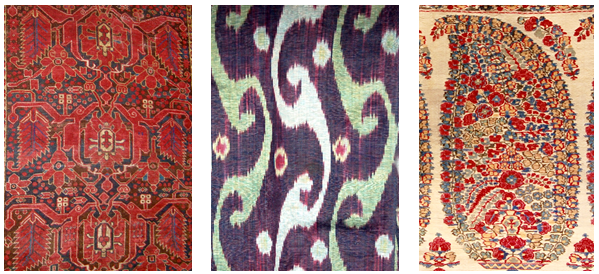
The process of weaving is one of
humanity’s most ancient technologies. The development of elaborately patterned
textiles, as opposed to non-patterned forms of woven cloth, requires a great
degree of technical expertise and is highly labor intensive. However, the
complex fabrication process implicit in a complex woven pattern would have
required the commitment to memory of a substantial amount of numerical and color
related information. Modern observation of traditional weavers in India and the
Caucasus suggests that this numerical information may have first emerged in the
form of memorized, rhythmic chants that allowed weavers to both remember
patterns and reproduce them as frequently as required. Moreover, the linguistic
and poetic associations between weaving and singing preserved in several
Indo-European languages also suggest that these chants were, at some point,
sources of rhythmic or possibly metrical narration in their own right.
Anthony Tuck is a
Professor of Mediterranean Archaeology in the Department of Classics at the
University of Massachusetts Amherst. He received his Ph. D. from Brown University
in 1996. Dr. Tuck is a specialist in Early Etruscan culture and
urbanization, and
today is the Director of Excavations at Poggio Civitate, an Iron Age and Early
Etruscan site in Tuscany, Italy, the best example of an Etruscan
community on the cusp of urbanism. Excavation in the past two years has revealed
a great deal of information, from burials to roads, that is changing the way the
site is understood by scholars. He has published extensively on topics including
Etruscan burial form, economics and urban development, and has recently worked
on the topic of ancient textile manufacture, including “Singing the Rug:
Patterned Textiles and the Origins of Indo-European Metrical Poetry” in the
American Journal of Archeology.
Dr. Tuck’s interest
in textiles began at an early age, with the blankets brought from Mexico by his
grandfather.
Community Hall, Lower Level St.
Bede’s Episcopal Church
3590 Grand View Blvd. Los Angeles, CA 90066-1904
Just south of the 10 freeway, and
west of the 405, near the intersection of Centinela and Palms. Free parking.
Admission: TMA/SC Members:
Gratis Guests: $10
Refreshments: If your last
name begins with C - H, please bring a plate of snacks / cookies /
fruit, that can be eaten as finger food, Assembled, On A Plate, Ready To
Serve, With A Serving Utensil. Plan to arrive before 2:00 p.m. with
your offering, and to help clean up after the meeting; please plan to take home
your leftovers.